Working paper v0.7 · An interactive research companion
PLATE 01 / THE LAGRANGE FAMILYOne exact family. A much larger question.
Start with the distinction
Special solutions. An open general question.
This page explores classical families with exact formulas and a local infinite series. It does not establish a general finite closed-form solution to the three-body problem.
Read with context. The mathematical derivations are coordinator self-review. The three-model AI study is exploratory and does not establish a reliable model ranking. Read the claims and limitations.
In gratitude
To the people who kept asking why.
To the observers who kept records, the mathematicians who found patterns, the teachers who made difficult ideas approachable, and the builders who gave others new ways to see.
This work stands within that human history. Some contributors are celebrated; many are unnamed. Their care made these questions ours to inherit. We offer this study with respect for what came before, and excitement for what people may discover next.
An original dedication for this project—not a quotation from a historical source.
A few landmarks in a much wider history
An unfinished conversation.
1687
Newton
The Principia joins laws of motion and universal gravitation into a mathematical account of celestial motion.
1767
Euler
Collinear configurations reveal exact special solutions: three bodies can remain on a rotating line.
1772
Lagrange
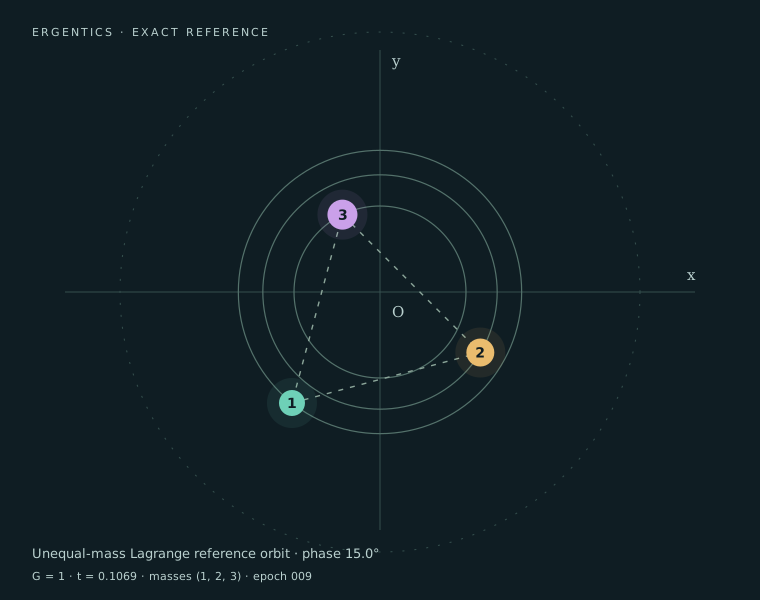
Equilateral configurations offer another remarkable family, including unequal masses.
LATE 1800s
Poincaré
Qualitative dynamics brings new ways to understand complexity beyond a single explicit formula.
1912
Sundman
Convergent-series work expands what an exact representation can mean. An infinite series is distinct from a finite formula.
AN OPEN FUTURE
All of us
Better explanations, careful computation, independent review, and new questions carry the work forward.
Selected landmarks, not a complete history or claim of priority. See the reading notes. The classical families belong to the history of mathematics; this project contributes its documented exploration and reference resources.
01 / Shape, mass & motion
Move through an exact solution.
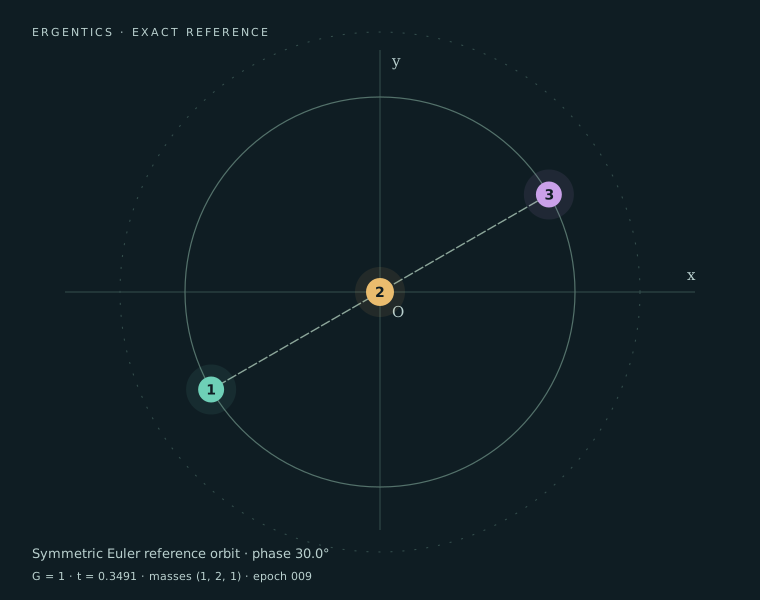
These positions come directly from a formula. You are changing its phase and parameters, not watching a numerical integration.
Outer masses = 1. Adjacent gap = 1. G = 1.
Physical time
0.3491
Angular speed
1.5000
Period
4.1888
The symmetric Euler family is collision-free for all real time and linearly unstable. An exact orbit need not be stable.
Motion starts paused. Use the phase slider for a still view. Playback uses one cycle per 14 display seconds; readouts use the formula’s physical time units.
Motion paused.
Inspect positions and velocities
Current exact state; coordinates in the reference plane, z = 0. G = 1.
Body
Mass
x
y
vₓ
vᵧ
Mathematics, written in motion
A line becomes an orbit.
For the symmetric Euler family, three positions share one rotating direction. The outer bodies mirror each other; the middle body rests at their center.
The rhythm of the rotation
a
Gap from the center to either outer body
m
Mass of each outer body
m₀
Mass of the middle body
G
Gravitational constant
Here θ is the phase, ω is the angular speed, and t is physical time. Written in the center-of-mass frame, with positive masses and a > 0. Phase is zero at t = 0; the slider selects a state on that orbit. Matching initial velocities are required. This symmetry describes a special family, not arbitrary initial conditions.
02 / A useful mistake
Same energy. Wrong starting point.
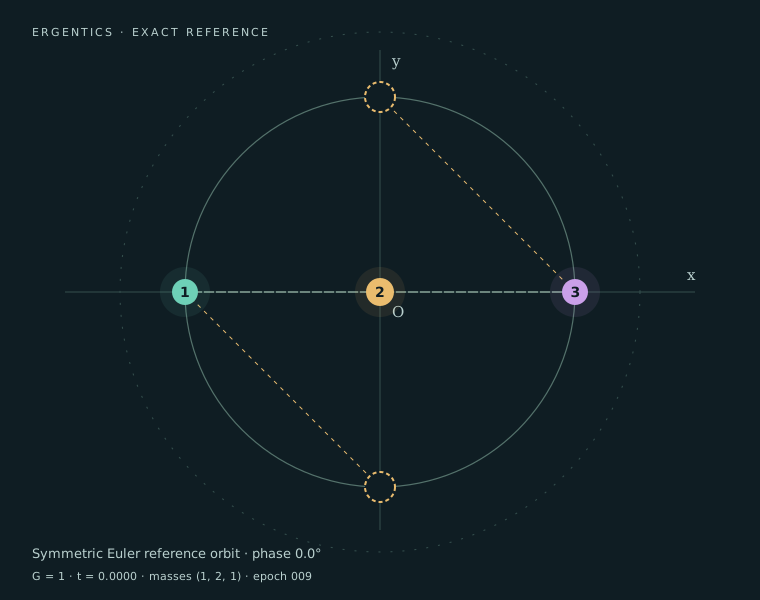
A shifted circular orbit has the same energy and angular momentum—and still misses the requested initial state. Move the shift to see what invariant checks leave out.
Energy, both orbits
−2.25
Angular momentum, both
3.00
Maximum position difference / a
1.4142
Filled bodies: requested reference. Outlined bodies: shifted comparison. Dashed segments: position differences.
Both satisfy Newton’s equations. A check of the intended initial positions and velocities detects the mismatch.
G = 1; masses (1, 2, 1); a = 1. This is a constructed analytical control, not a measured software failure.
03 / Knowing the boundary
A useful bound has an edge.
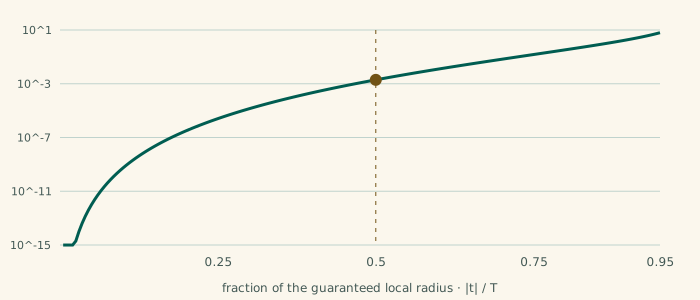
The paper’s infinite local series covers general distinct-position initial data. Its truncation bound is explicit, but guaranteed only inside a conservative local radius.
Position bound / δ1.953 × 10⁻³
Bound / δ = ηN+1 / [2(1 − η)], where η = |t|/T < 1 and δ is the initial minimum separation divided by 16. Vertical values below 10⁻¹⁵ are clipped on the plot; the readout retains them. This excludes floating-point roundoff and does not represent a measured error or a collision time.
Read the research
Wonder, with the workings shown.
What the mathematics establishes
Explicit classical circular families, the fixed-planar-shape boundary, linear instability of the symmetric Euler family, and an infinite local series with a convergence radius and truncation bound.
Three original responses under a shared prompt and profile, followed by an unblinded synthesis. A reported intake deviation is retained. The study supports inspection of these outputs, not a model ranking.
No general finite closed form, independent mathematical certification, protected examination, numerical trajectory study, or measured learning or deployment benefit is established.
All-time special-family motion is distinct from a general local series. A display check is distinct from a mathematical examination.
About this website edition
This first website epoch is a visual companion to manuscript v0.7. The included Markdown edition carries its scientific main text, declarations, and reading notes, with internal file links and local operational records removed from the deployable files. The full research record retains the original model responses, configurations, and review history. This page explains the results; the manuscript provides their assumptions and limitations.
Excitement for what comes next
More people able to see, question & contribute.
The next step can be modest and meaningful: help someone catch a wrong calculation, understand a difficult distinction, or follow an idea all the way back to its evidence.
01
Build trust by checking
Compare an independent implementation with exact reference cases, including examples designed to expose misleading agreement.
02
Make understanding shareable
Pair motion with equations, words, and inspectable states. Then ask whether people learn something they can use elsewhere.
03
Keep the invitation open
Credit inherited knowledge, preserve uncertainty, and give future contributors a clear place to begin.
These are directions for future evaluation. Their educational, accessibility, efficiency, and societal effects have not been measured.
Reading notes & acknowledgment
The ideas have a history.
Newton, I. Philosophiæ Naturalis Principia Mathematica (1687). Historical landmark.
Marchal, C. The Three-Body Problem. Elsevier (1990). Background on classical celestial mechanics and solution families.
Sundman, K. F. “Mémoire sur le problème des trois corps.” Acta Mathematica 36, 105–179 (1912). Historical series representation.
Bibliographic context, not an exhaustive literature or priority review. The cited full texts were not newly retrieved during this website epoch. The local Taylor bound shown here is not a recreation of Sundman’s full theorem.
Ergentics, LLC directs this project. Codex supplied mathematical exposition, coding, and editorial assistance. Classical mathematical contributions are credited to their history; the current derivations and presentation are coordinator self-review.