Ergentics · Research / Spacecraft theory
Novelty and usefulness in shape-controlled gravitational propulsion
A post-study assessment of a three-mass spacecraft hypothesis
Ergentics, LLC · Working paper 028 · Web edition 029 · 23 September 2026
Abstract
Objective. This paper asks what a finite calculation of shape-dependent gravity establishes, and what additional evidence would support an original, useful spacecraft propulsion design. Methods. We assess the completed Ergentics 027 study against selected primary tether research. That study evaluated thirteen configurations of three equal onboard masses in a Newtonian point-primary field, three prescribed external-potential work maps, and isolated, uniform-field and linear-field controls. Swift, C++ and Objective-C implementations were checked under a frozen finite protocol. Results. All three declared native invocations passed. At a geocentric distance of 7,000 km, a 1,000 kg idealized craft with a 200 m end-to-end span produced radial and transverse force differences of approximately −3.32 and +1.66 μN relative to point-mass gravity. Both total forces remained inward. The prescribed work map transferred energy supplied through shape change; it did not produce an energy surplus. Primary literature already describes gravity-coupled tether pumping. Interpretation. The results support the stated finite gravitational coupling and its accounting controls. They establish neither a novel physical mechanism nor mission utility. A distinct configuration or control architecture remains a research possibility. Its usefulness would require a realizable internal-state cycle, complete energy and momentum accounting, and a mission-specific comparison with established alternatives. This post-study analysis defines those questions without treating an untested possibility as a negative result.
Keywords: gravitational propulsion; tether dynamics; spacecraft configuration; finite-size gravity; research reproducibility; AI-assisted research.
1. Introduction
The originating question was whether geometry studied in the three-body problem could suggest a new propulsion mechanism. It is a productive question when the system boundary, energy source and momentum exchange partner are made explicit. The earlier mathematical work concerned unforced special families. A controlled three-mass craft interacting with an external primary is a different dynamical system: making the primary dynamical introduces a fourth gravitating body.
The relevant historical foundation is unusually direct. Landis describes orbital energy transfer through tether-length changes, powered onboard and coupled to the external gravitational field [1,2]. Guéron, Maia and Matsas distinguish related Newtonian shape-cycle effects from relativistic swimming [3]. NASA/JPL's gravity-assist account offers a separate example of why an external energy and momentum partner matters [4]. These contributions give the present hypothesis a physical context and a prior-art boundary.
This paper separates three questions: whether the stated gravitational coupling exists in the model; whether a proposed design adds something distinct to prior work; and whether that design improves a defined mission outcome. Evidence for one question does not settle the others. The purpose is to make further exploration more discriminating while retaining its imaginative starting point.
2. Research question and hypotheses
The central question is: Can a controlled three-mass geometry yield a distinct, useful method of orbital control after its energy, momentum and engineering costs are included? The completed study addresses necessary physical and computational conditions. It does not answer the complete engineering question.
The following statements restate the scope of the frozen 027 calculations and separate it from prospective research. Their organization here is retrospective; this paper is not a new preregistration or evidence that the later interpretations were selected before the observations.
| Statement | Test or evidence | Present finding |
|---|---|---|
| H1: Finite geometry can change the center-of-mass force in a nonlinear external gravitational field. | Exact forces compared with a point-mass reference in the thirteen fixed cases. | Supported for the selected configurations and model. |
| H2: Internal motion alone supplies no isolated-system center-of-mass force in this Newtonian model. | Internal pair-force sum; uniform- and linear-field controls; conservation argument. | Consistent with the calculated zero controls. |
| H3: The prescribed closed potential map transfers the external-potential work supplied through shape change. | Forward, reverse and equal-radius maps; energy and torque residuals. | Supported for those prescribed maps; a realizable flight maneuver was not tested. |
| H4: A particular triad architecture or controller offers a contribution beyond known tether methods. | A specified design and direct comparison with relevant prior work. | Open; no distinctive architecture or controller was qualified. |
| H5: Such a design improves a defined mission outcome under comparable resource constraints. | Coupled dynamics, full system costs, comparative performance and later physical validation. | Open; no mission performance or apparatus measurement was produced. |
H4 and H5 are future questions. Their absence from the completed test is not a demonstration that all possible designs fail. Equally, H1 cannot substitute for evidence of H4 or H5.
3. Model and methods
3.1 System boundary and governing equations
Let the primary's gravitational parameter be . The craft has total mass , three equal onboard masses and center-of-mass position relative to the fixed primary. Their controlled offsets satisfy . The external potential and instantaneous center-of-mass acceleration are
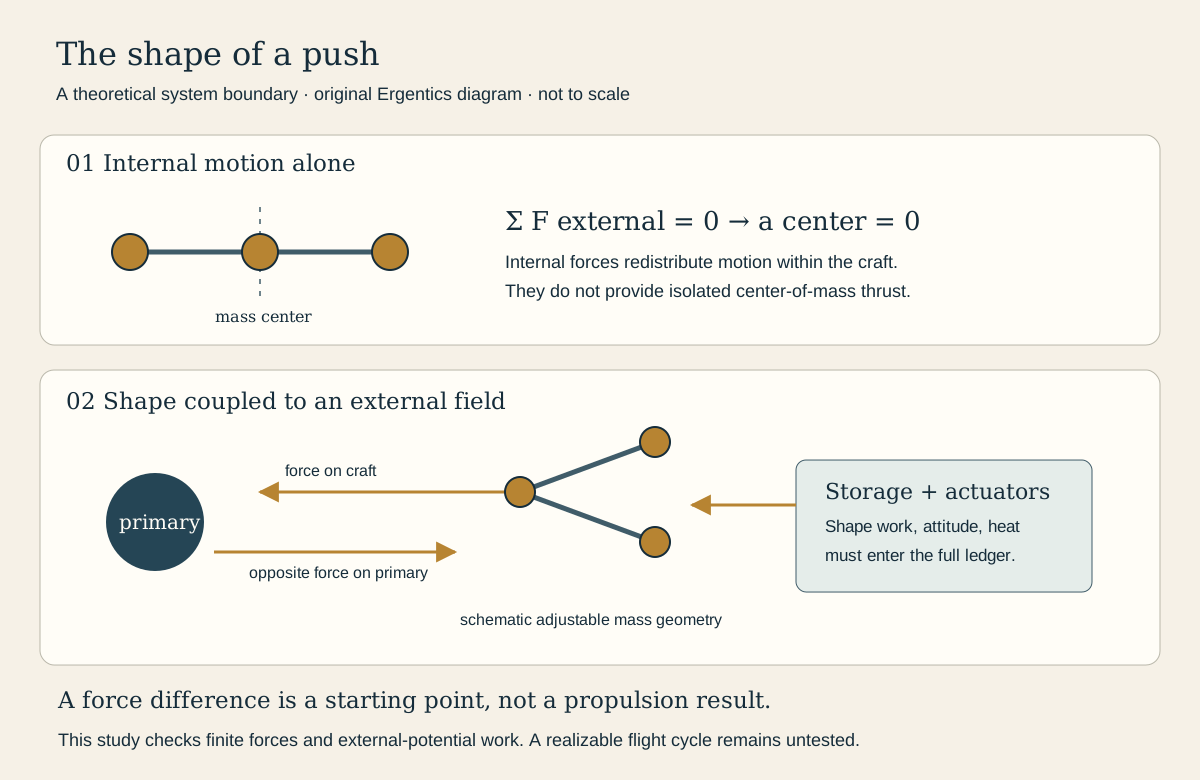
Here denotes configuration. The force difference from the point-mass reference is , where . It is not an independently generated force in otherwise empty space. The primary receives the opposite gravitational force in the complete interacting system; its recoil is not integrated in the fixed-primary calculation.
For the symmetric line with offsets , the leading radial and transverse differences are
Thus geometry changes how mass samples the external field. A uniform field gives the same acceleration to all masses. A field linear in the offsets also gives no center-force correction because their mass-weighted mean is zero. The center-force effect in Equation (2) requires spatial curvature of the acceleration field. Linear tides may still produce internal stress or torque.
3.2 Prescribed work map
For a radial line the study prescribed contraction at a near radius and extension at a far radius, with fixed-span radial legs between them. This closed path in space allows an exact external-potential accounting identity:
The identity follows because the potential returns to its initial value. It accounts for the external gravitational component only. No trajectory, cycle duration, actuator dynamics, structural model, power consumption or efficiency is inferred from it. An actual maneuver may also require control on the center-motion legs, which the imposed map does not specify.
3.3 Computational and documentary method
The 027 protocol fixed the thirteen inputs, three work-map variants, three physical controls, acceptance rules and one invocation per native language before numerical qualification [D1]. Swift produced the values and checked physical predicates; C++ compared the resulting TSV with a separately written reference; Objective-C validated the JSON, reconstructed fields and exercised specified negative controls. Each invocation ran once, without retries [D2].
The numerical comparison bound was . This is a finite implementation-agreement criterion, not a physical uncertainty, statistical confidence interval or a uniform error theorem. C++ reported 53 significand bits for both double and long double. The reference therefore did not supply extended precision on the tested platform.
The source trace was targeted: the retained Landis conference text, selected NASA/JPL material and primary relativistic/Newtonian comparison papers were inspected in the preceding study [D3]. The related Landis journal record was identified bibliographically; its full text was not newly read. This revision uses those observations and recorded outputs. No scientific executable, additional model panel, new numerical experiment or new literature search was run for 028.
4. Results
4.1 Finite force contrast
All three native invocations exited successfully. The illustrative Earth case used , geocentric , half-span , and . The line's end-to-end length was 200 m.
| Orientation | Recorded (m/s²) | , rounded (μN) | Interpretation |
|---|---|---|---|
| Radial | −3.3202868966 × 10⁻⁹ | −3.3203 | More inward acceleration than the point reference. |
| Transverse | +1.6601434473 × 10⁻⁹ | +1.6601 | Less inward acceleration than the point reference. |
Both total accelerations were inward, approximately . The micronewton values are computed differences between idealized gravitational configurations. They are not thrust-stand measurements, a demonstrated continuous thrust level, or a mission-integrated impulse. No structural feasibility or cost was assigned to the 200 m arrangement.
4.2 Work and symmetry controls
The synthetic work example used , , near/far radii 10/20 and short/long half-spans 0.05/0.1, in SI units. The recorded forward-map values were
after display rounding. Reversing the map changed both signs; using equal radii gave zero. The stored arithmetic balance was zero in each map. This result is consistent with transfer of supplied work through a known gravitational coupling. It is not a complete actuator or battery budget.
The isolated, uniform-field and linear-field controls produced zero center-force residuals. Oblique orbital and internal torques balanced within the frozen bound. Halving the small line span gave a force difference near one quarter of its original magnitude. The two triangle orientations had matching leading quadrupoles while retaining a higher-order difference in the exact force. Full-precision values and the complete finite-case table remain in the original record [D2].
4.3 Validation outcome
C++ rejected the two specified malformed TSV variants. Objective-C accepted the original JSON and its whitespace reencoding, and its aggregate passing path required rejection of fifteen specified mutations, including omitted shape work and unsupported positive claim flags. It did not produce an individual runtime log for each rejection. These controls document finite data and claim-boundary behavior; they are not physical experiments or comprehensive parser certification.
5. Discussion: where novelty could reside
Novelty should identify a specific contribution and the work against which it is compared. Changing spacecraft shape in an external gravitational field, supplying onboard energy and avoiding onboard expellant does not by itself distinguish this proposal from Landis's tether-pumping treatment [1,2]. The phrase “reactionless” in the historical title cannot erase the gravitational exchange partner.
| Possible contribution | Evidence in the present record | What a defensible claim would still require |
|---|---|---|
| A new physical interaction or force law | None; the calculations use ordinary Newtonian gravity. | A specified alternative law and reproducible evidence discriminating it from known interactions and error. |
| The broad gravity-coupled shape-cycle mechanism | Direct prior overlap with tether research. | The broad mechanism should be attributed to prior work. |
| A distinct triad architecture or control law | Idealized geometries are evaluated; no complete controller is qualified. | A precise design, closest-predecessor comparison and evidence of a distinguishing capability. |
| The present research artifact | An inspectable finite calculation, cross-language checks and explicit negative controls. | Its existence is documented; priority or methodological novelty needs a separate comparison. |
This distinction leaves room for engineering originality. A contribution might lie in a configuration, an actuator arrangement, controllability, a robustness property or a verification technique. Those are candidate directions, not results of this study. AI models proposing similar descriptions does not establish priority. The targeted trace also cannot establish the absence of a predecessor for every possible implementation.
6. Discussion: what would make the idea useful
The immediate demonstrated use of the artifact is bounded: its finite checks expose specified accounting and data defects, and its paper makes the reaction partner and supplied work inspectable. Educational improvement, development productivity and spacecraft performance were not measured. A small force difference may matter in some long-duration tasks, but that possibility cannot be quantified by multiplying one static snapshot by an arbitrary duration.
A useful propulsion or orbital-control result would start with a mission objective and a comparison that gives both designs the same relevant constraints. These may include initial orbit and payload, available energy, total system mass, allowed duration, reliability requirements and deployment envelope. The baseline should include a fixed-geometry craft; conventional tether control or an established propulsion method should be compared where it serves the same task. The appropriate baseline depends on the mission rather than on which comparison looks favorable.
The next study would need to evolve geometry, attitude, actuators and orbital state together. “Cycle closure” should mean restoration of the relevant internal state or explicit accounting for its net change. It need not mean returning the orbital state to its starting point: changing that state can be the intended outcome. Internal kinetic energy, stored elastic energy, onboard gravitational energy, storage draw, recovered energy, thermal loss and momentum exchanges must all be allocated consistently. A general accounting requirement is
for the specified system, with each term defined before execution. Mechanical energy must include the kinetic and potential terms for all modeled bodies; import/export terms account for exchanges across that boundary. Equation (5) is a proposed future accounting requirement, not a ledger computed in 027.
Numerical error and external disturbances must be bounded tightly enough to resolve the predicted differential effect. A later physical test would additionally need a measurement model and controls for vibration, thermal forces, electromagnetic coupling, support reactions and environmental gradients appropriate to its setup. No apparatus or experimental sensitivity is supplied here.
An engineering benefit would be a reproducible improvement in the chosen mission outcome after those costs are included, with uncertainty small enough to distinguish it from the baseline. If an apparent gain vanishes when internal state is reset, or established alternatives dominate under the same constraints, the proposed design should be revised or redirected. These are useful research outcomes too.
7. Limitations
The completed study uses instantaneous point-mass configurations and a fixed-primary Newtonian potential. It excludes structural mass, flexible-body dynamics, actuator and attitude control, time-dependent orbital integration, environmental forces, primary recoil trajectories and measured hardware. The imposed work rectangle is not a realizable maneuver specification. Thirteen deterministic cases and a finite tolerance do not constitute a convergence study or a universal error bound.
The source trace is incomplete as a novelty assessment. The Landis conference record's proceedings date differs from the year suggested by its accession prefix; the discrepancy is preserved in the references. Relativistic swimming sources provide context and distinctions, not evidence for this Newtonian craft [3,5].
Three AI model roles cooperated in the preceding study, with a shared suggested lens, shared filesystem, unblinded synthesis and unknown serving builds. Their work is not independent mathematical certification or a controlled model comparison. The present revision is coordinator-authored post-study synthesis and has not received a fresh three-model or external peer review. No statistically measured educational, environmental, resource-saving or societal benefit is reported.
8. Conclusion
The finite study establishes an inspectable example of known geometry-dependent gravitational coupling and confirms its selected conservation and data controls. It also identifies direct historical overlap, so the broad mechanism does not support a claim of new physical discovery. Novelty at the level of a specific architecture or controller, and usefulness for a specified mission, remain open questions requiring different evidence.
The constructive next step is a fully accounted, realizable control cycle with a fair baseline and resolvable error. That path preserves room for invention while giving success and failure meanings that can be checked. For peaceful exploration, clear limits and reusable evidence are practical contributions to the collective work on which future spacecraft will depend.
Contribution, AI assistance and data availability
Ergentics supplied the originating research direction and the request for this post-study assessment. Codex coordinated the earlier Swift/C++/Objective-C work and prepared this revision from its retained evidence. The requested model labels and their individual contributions are preserved in the original role reports [D4]. Human research direction, classical prior work, model assistance and local code authorship remain distinct. No NASA or JPL participation in this study is claimed.
The scientific text is adapted from the versioned Ergentics paper. The public evidence note and recorded values make its finite observations inspectable. The complete research record retains protocols, source and attributed reviews separately. This web edition changes presentation and evidence links; it adds no scientific result or new experiment.
References
- Landis, G. A. Reactionless propulsion using tethers. In Vision-21: Space Travel for the Next Millennium. NASA NTRS record 19910012850. Retained primary PDF and extracted text inspected. The NTRS proceedings field lists 1 April 1990; the accession prefix begins 1991. The discrepancy is retained.
- Landis, G. A. (1992). Reactionless orbital propulsion using tether deployment. Acta Astronautica, 26(5), 307–312. doi:10.1016/0094-5765(92)90076-U. Bibliographic record inspected; full journal text was not newly read.
- Guéron, E., Maia, C. A. S., & Matsas, G. E. A. (2006). Swimming versus swinging effects in spacetime. Physical Review D, 73, 024020. doi:10.1103/PhysRevD.73.024020. Retained author preprint inspected.
- NASA/JPL. Basics of Space Flight, Chapter 4, Gravity Assist. Agency educational reference. Read in the 027 source trace on 23 September 2026.
- Wisdom, J. (2003). Swimming in spacetime: Motion by cyclic changes in body shape. Science, 299, 1865–1869. Author-hosted paper. Relativistic context; this study does not implement its model.
Supporting research record
- D1–D2: Scope, recorded results and validation limits.
- D2: Original finite JSON values.
- D3: Primary-source reading limits.
- D4: The preceding study used the requested labels gpt-6-astra, gpt-6-sol and gpt-5.6-terra for Swift, C++ and Objective-C roles. The complete record retains their original proposals and reviews. Serving builds were not independently identified; the current revision has coordinator review only.