What agrees
Energy: −2.25.
Angular momentum: 3.00.
Both orbits satisfy Newton’s equations.
A GALLERY OF MATHEMATICAL IDEAS / 001
An equation keeps an insight available to another person. Meet the people, shapes and questions behind three bodies in motion, then inspect an exact family, an apparent match, and the boundary of a local series.
Working paper v0.7 · Website edition 029
Explore exact classical families and an infinite local series. This exhibition does not establish a general finite closed-form solution. Read what is established and what remains open.
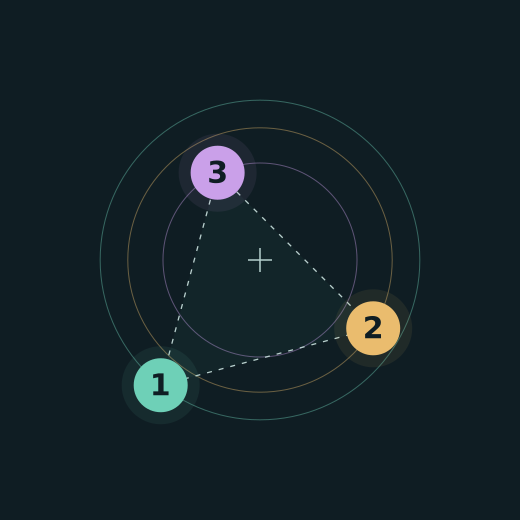
Five encounters / a selected history
Give an idea room. Name the person and the work. Stay with the question long enough for a relationship to become visible.
This art is important. Let’s put it in an important building.
George Lucas, quoted on the Lucas Museum’s campus page.
That care for narrative art inspires this Ergentics gallery. The museum was founded by George Lucas and Mellody Hobson; its account of art as a shared human encounter informs our approach. The mathematical diagrams and narration here are original modern presentations. Read the inspiration trace.
A small gallery of people, relationships and the patient work of understanding. Follow the labels into the original texts; follow the diagrams into the mathematics.
Read the labels closely. “Primary text” names a source read for the nearby historical claim. “Archive catalogue” preserves a route where primary access was unavailable. “Modern reference” and “contemporary interpretation” name original Ergentics teaching or art objects; neither is historical evidence. See the source guide.
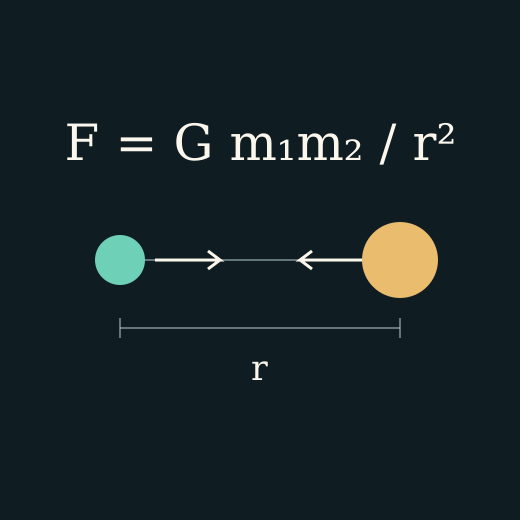
01 / Isaac Newton / 1687
What if motion in the heavens could be described through the same mathematical relationships we use on Earth? In the Principia, mutual attraction belongs to a common account of matter and motion.
Look for the relationship: a greater separation weakens the pair force.
Read the force law in §2.1 ↗Primary text · Latin transcription
Principia · Laws I–III; Book III, Proposition VIITranscribed by Jonathan Ingram, Keith Edkins and the Online Distributed Proofreading Team. Their work makes this text newly reachable.
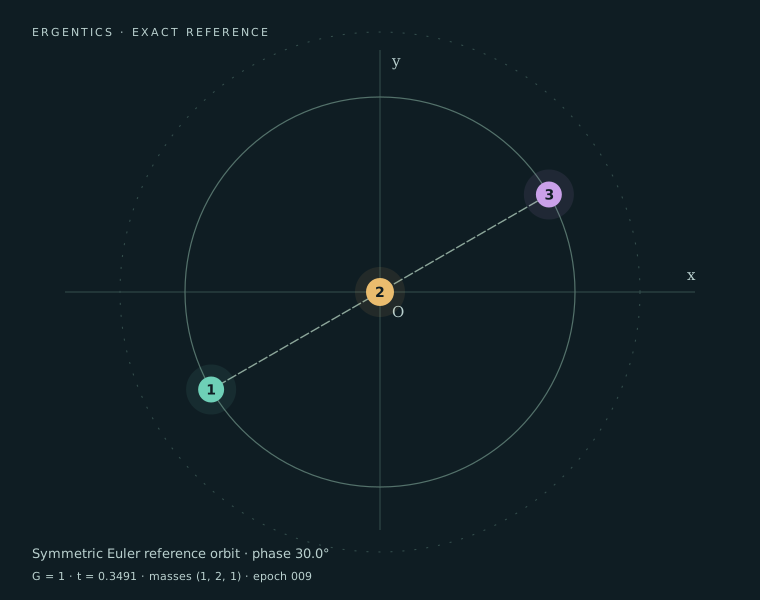
02 / Leonhard Euler / 1763 → 1767
Three bodies need not lose every simple shape. Euler studied their mutual attraction on a straight line. Our workbench separately presents a symmetric rotating member of the classical collinear family.
Look for what stays fixed while the direction changes.
Inspect the exact families ↓Archive catalogue · original text access pending
Euler Archive E327 · written 1763, published 1767The catalogue establishes the work and dates. Its original PDF was inaccessible during this trace; the rotating reference is checked in our own derivation.
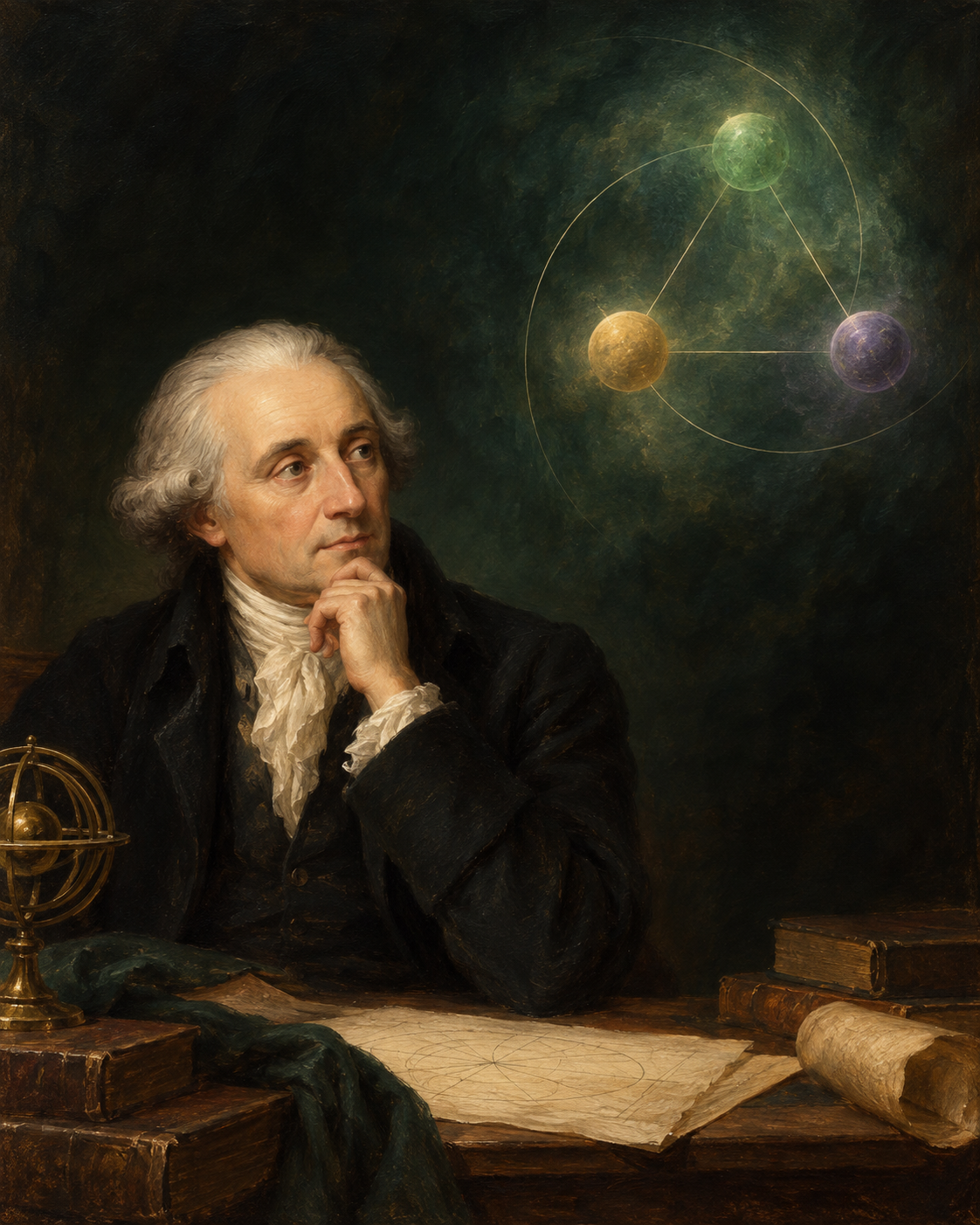
03 / Joseph-Louis Lagrange / 1772
Begin with what lies between the bodies. Lagrange introduces his method through their three mutual distances—the triangle they form at each instant. A relationship becomes a way of seeing the whole.
A shared shape can hold unequal lives in balance.
In the circular equilateral family below, unequal masses move at different radii while every side stays the same length.
Change the view of this triangle ↓Primary text · collected-edition transcription
Essai sur le Problème des trois Corps · Avertissement, pp. 229–230Wikisource revision 13975608, Œuvres, tome VI. The companion portrait is a contemporary interpretation, not an authenticated likeness or historical painting.
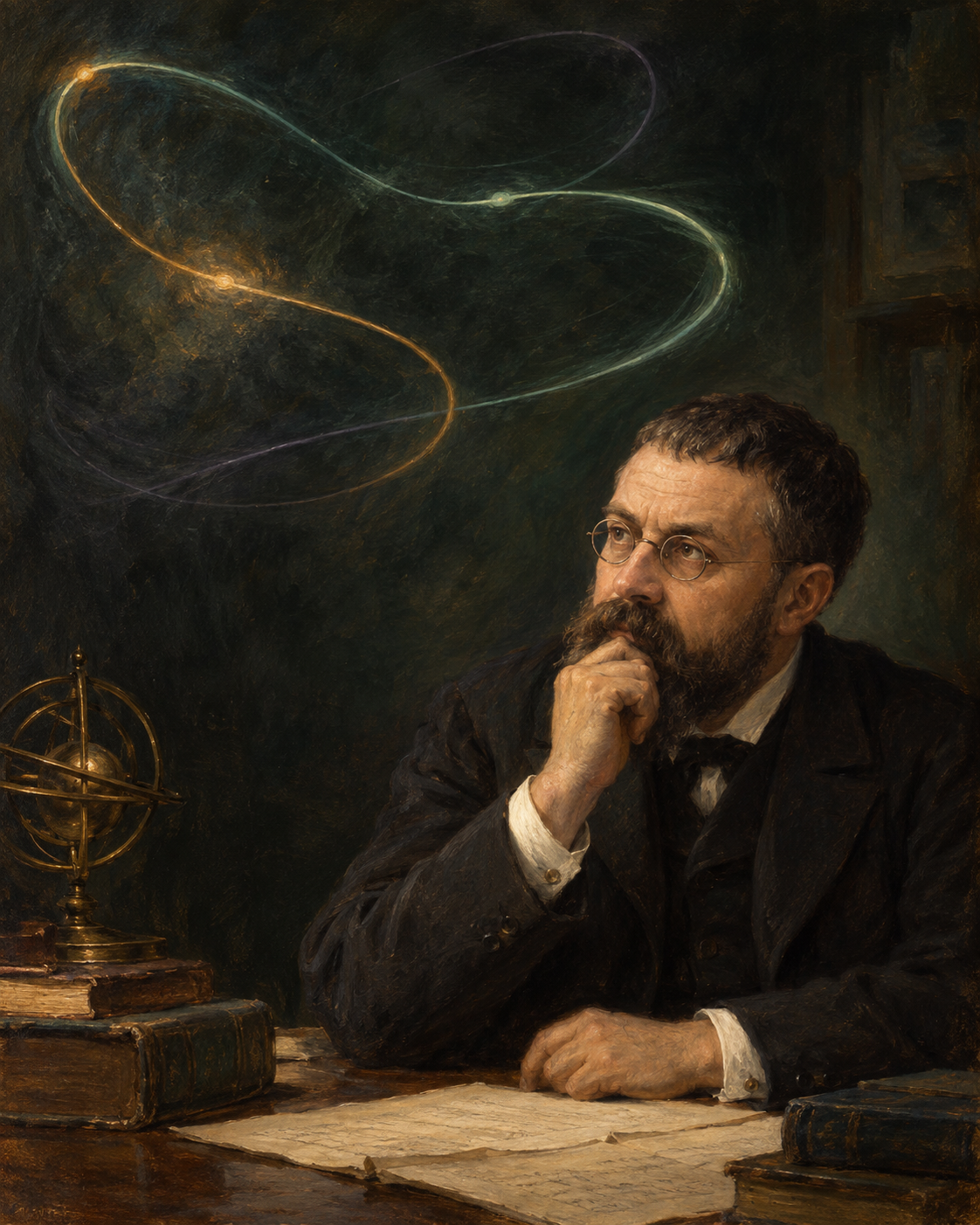
04 / Henri Poincaré / 1890
In the introduction to his revised memoir, Poincaré thanks Edvard Phragmén: a careful question helped him discover and correct an important error. The history of mathematics includes the people who help us see what we missed.
What does your evidence establish—and what can it miss?
Challenge an apparent match ↓Primary text · author's acknowledgment
Introduction · Acta Mathematica 13, pp. 5–7 · acknowledgment p. 5The portrait and returning paths are contemporary interpretations, not an authenticated likeness or a mathematical proof.
05 / Karl F. Sundman / printed 1912 · catalogued 1913
Sundman asks us to take an infinite representation seriously. His closing theorem changes the time variable and states a nonzero-angular-momentum condition, together with a convention for continuing through collisions.
Read the boundary of a guarantee as carefully as the formula.
Our local Taylor series is a separate construction, with its own limited domain.
Explore the local bound ↓Primary text · article scan
Mémoire sur le problème des trois corps · §34, pp. 178–179The opening leaf says “Imprimé le 8 juillet 1912.” The publisher catalogues the work as 1913. Both pieces of evidence belong in its history.
And around every named work: teachers, translators, librarians, makers of instruments, careful readers. This gallery is one path through a much wider human inheritance.
The viewing room / a study in perception
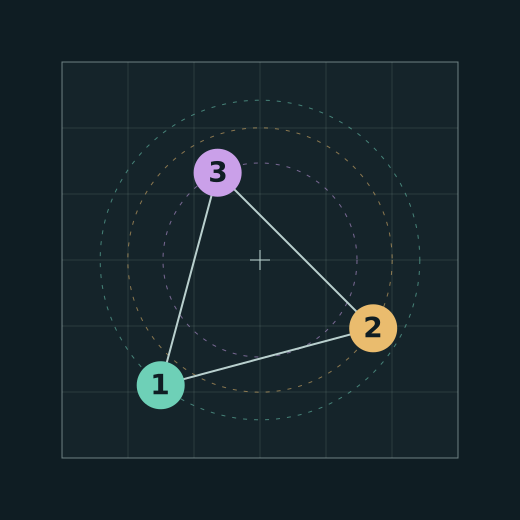
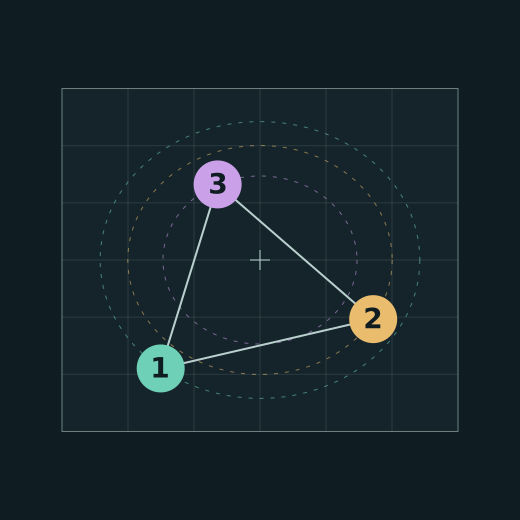
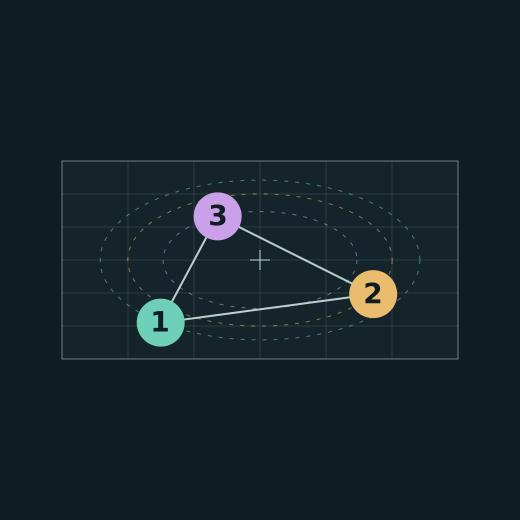
The triangle is still. Tilt the view and its silhouette narrows. Its three sides remain one unit long in the mathematical plane. A picture and the thing it describes are related, but they are not interchangeable.
You choose the viewpoint
Arrow keys change one degree. Home returns to the plane; End selects 60°. These controls change the view, not the orbit’s time.
Plan view. The physical state is fixed.
Each physical side1.00000 unit
How the depth is made. Foreshortening, a reference plane and depth ordering supply visual cues on this flat screen. This is an orthographic projection, not stereoscopic output. We have not measured a perceptual improvement.
With camera tilt α, X = x, Y = y cos α, Z = y sin α. Physical z remains zero; camera Z measures depth in the view. Screen distances generally shrink. Trace the design foundations.
| Body | Physical x | Physical y | Camera Y | Camera Z |
|---|---|---|---|---|
| 1 | -0.45138 | -0.56924 | -0.56924 | 0.00000 |
| 2 | 0.51454 | -0.31042 | -0.31042 | 0.00000 |
| 3 | -0.19257 | 0.39669 | 0.39669 | 0.00000 |
Still editions: plan · 30° · 60°. The comparison is available without animation or JavaScript.
The shape of the inquiry
What does it mean to solve a motion? Begin with an exact shape, challenge an apparent match, then examine the limits of an infinite local series. These studies do not establish a general finite closed-form solution to the three-body problem.
Read with context. The mathematical derivations are coordinator self-review. The three-model AI study is exploratory and does not establish a reliable model ranking. Read the claims and limitations. How these inquiry examples were checked.
CHAPTER 01 / SHAPE
The formula gives each state directly. Choose a family and phase to inspect its motion; this display does not numerically integrate a trajectory.
These are three exact states of the same circular Lagrange orbit: masses (1, 2, 3), side length 1. Every side stays the same length as the triangle turns.
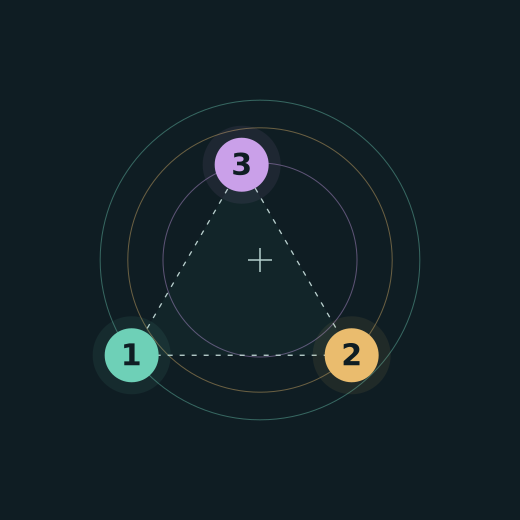
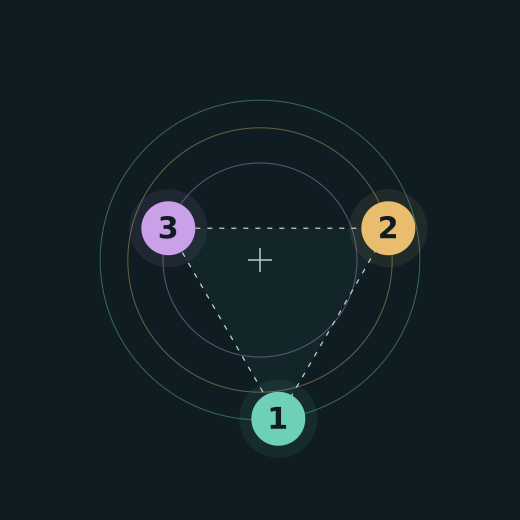
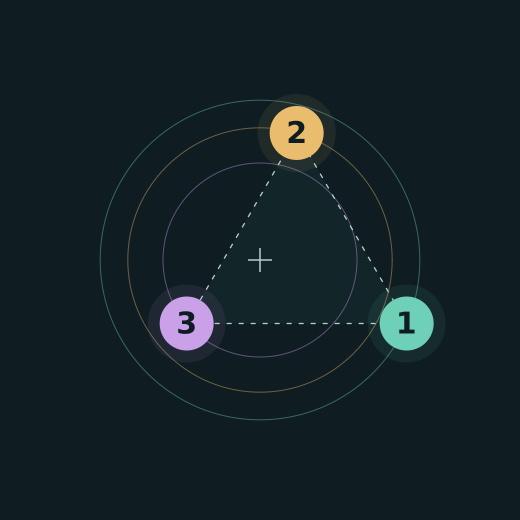
Select a family, then move its phase. The formulas below follow your choice.
The saved figures and explanations are available below. Interactive controls become available when JavaScript finishes loading.
Outer masses = 1. Adjacent gap = 1. G = 1.
Keyboard: arrows move 1°; Shift + arrows move 0.1°; Page Up/Down move 15°; Home/End select 0°/360°.
The circular symmetric Euler family is collision-free for all real time and linearly unstable. An exact orbit need not be stable.
Playback targets one cycle per 14 display seconds; a quarter-turn targets 3.5 seconds and then pauses. Slow or interrupted rendering can lengthen both. With reduced motion, quarter-turn shows its endpoint immediately.
The time readout measures physical time from phase zero in reference units and returns to zero each cycle. It is not elapsed viewing time.
Motion paused.
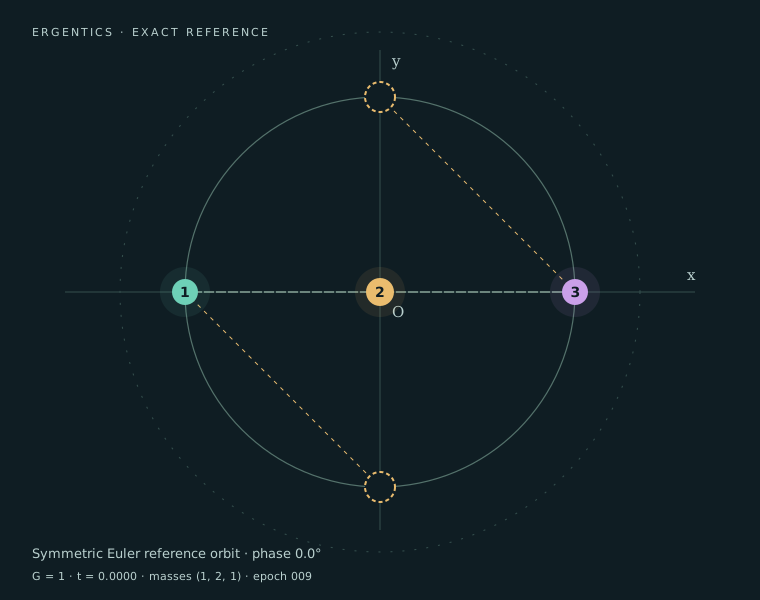
The horizontal axis is x; the vertical axis is y; O marks the center of mass. Numbered markers identify bodies and are enlarged on narrow screens; they do not show physical sizes. The table below gives coordinates and velocities rounded to five decimal places.
| Body | Mass | x | y | vₓ | vᵧ |
|---|---|---|---|---|---|
| 1 | 1.0 | −0.86603 | −0.50000 | 0.75000 | −1.29904 |
| 2 | 2.0 | 0.00000 | 0.00000 | 0.00000 | 0.00000 |
| 3 | 1.0 | 0.86603 | 0.50000 | −0.75000 | 1.29904 |
Mathematics, written in motion
For the symmetric Euler family, three positions share one rotating direction. The outer bodies mirror each other; the middle body rests at their center.
The minus and plus signs place the outer bodies on opposite sides of the center. The distance a stays fixed.
Here θ is the phase, ω is the angular speed, and t is physical time. Written in the center-of-mass frame, with positive masses and a > 0. Phase is zero at t = 0; the slider selects a state on that orbit.
Matching initial velocities are required. This symmetry describes a special family, not arbitrary initial conditions.
The initial vertices are s₁ = (0, 0), s₂ = (a, 0), s₃ = (a/2, √3 a/2). Subtracting c centers the triangle. R(θ) sends (x, y) to (x cos θ − y sin θ, x sin θ + y cos θ).
Here G = 1, a = 1, and masses are (1, 2, 3), so ω = √6. The motion lies in z = 0. Matching initial velocities are required: vᵢ = ω(−yᵢ, xᵢ, 0). This is the circular Lagrange family; arbitrary initial data need not preserve this triangle.
CHAPTER 02 / EVIDENCE
A phase-shifted circular orbit keeps the same energy and angular momentum, yet can miss the requested initial state. Change the shift to compare positions and velocities.
Energy: −2.25.
Angular momentum: 3.00.
Both orbits satisfy Newton’s equations.
Do the positions and velocities match the requested state at the requested time?
Positions and velocities differ.
Both gaps are dimensionless: position is scaled by a, velocity by aω. Compare corresponding body identities. At 180°, the two outer positions exchange places; the labeled initial state still differs.
Filled bodies: requested reference.
Outlined bodies: shifted comparison.
Dashed segments: position differences.
Check both gaps to decide whether the labeled initial states match.
G = 1; masses (1, 2, 1); a = 1. This is a constructed analytical control, not a measured software failure.
Shift 90°. Maximum position difference / a: 1.4142. Maximum velocity difference / (aω): 1.4142. The initial states differ. Energy and angular momentum are unchanged.
Ergentics Music Theory · A recital in three movements
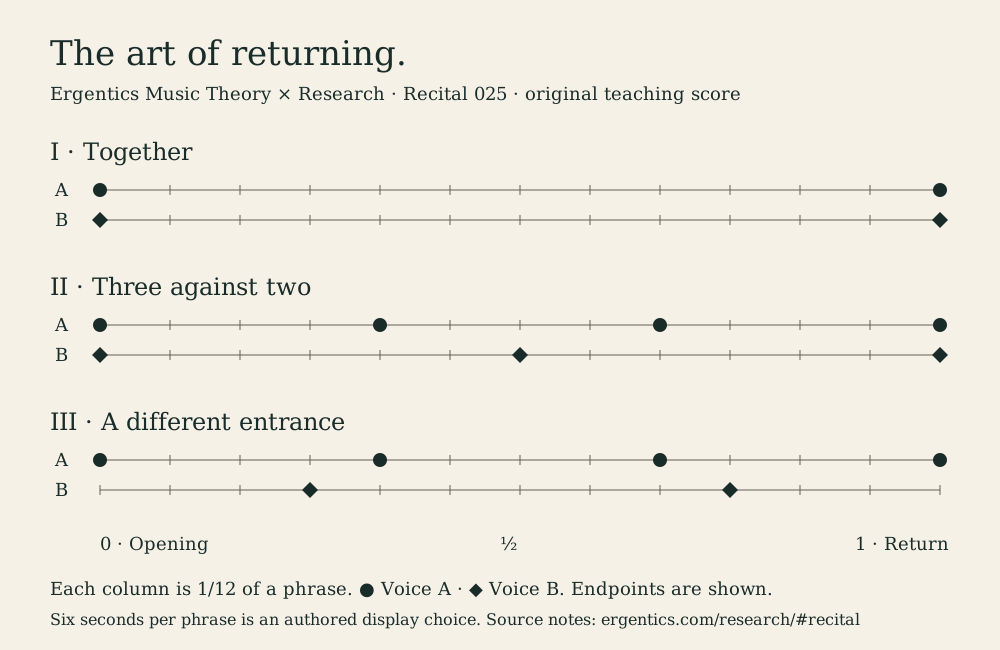
A musician counts the space between entrances. A mathematician asks what returns—and what stays unchanged. Follow two voices through one phrase, and see how a small change of phase transforms their meeting.
A small performance. An open score.
Hear a shared pulse become a conversation, then shift one entrance. Two pure tones carry the voices; a brief rest separates each movement. Start with a comfortable device volume.
Three movements, once through. About 20 seconds at the measured pace. This button enables sound.
The score · six seconds per phrase
A strikes at 0, ⅓ and ⅔ of the phrase. B strikes at 0 and ½. Both return to their starting phase at 1.
Exact onsets, in twelfths: A · 0, 4, 8, 12; B · 0, 6, 12. The closing boundary is included.
Pure tones: A · 220 Hz, B · 330 Hz. Listening to one voice leaves both visible in the score.
The score is readable without playback. Sound is optional.
Use the phrase slider or arrow keys to inspect a still moment. A hand reaching twelve o’clock marks a strike. Sound, pace and voice changes stop playback so you can choose a new starting point.
The connection
In this score, each hand records a repeating rhythm. In the circular Lagrange and Euler examples above, one rotation carries the whole configuration: every body has the same angular speed. Their radii may differ.
Return to the exact circular families →The distinction
Three against two describes the rhythmic counts. The tones’ 330:220 frequency ratio is a separate musical choice. Neither ratio is assigned to the gravitating bodies. This authored listening aid invites a question; it does not establish a physical equivalence or reproduce sound from an orbit.
Let u be the fraction of a phrase. The two phases, in turns, are pA = a·u mod 1 and pB = (b·u + δ) mod 1. A strike occurs at an integer turn. The three movements use (a,b,δ) = (1,1,0), (3,2,0), (3,2,½). The selected phrase lasts four, six or nine seconds. This display time is separate from physical orbital time.
For movement II, the cycle lengths are two and three cells on a six-cell grid. Their common period is lcm(2,3) = 6. These cycle lengths are distinct from the counts of strikes per phrase. In movement III, B strikes at ¼ and ¾; A still strikes at 0, ⅓ and ⅔. No strike times coincide, although the pair of phases repeats after one phrase.
The complete recital includes each closing strike and its release, then a short silent interlude before the next movement. It ends after movement III. Selecting another movement, seeking, changing sound or hiding the page cancels it; returning to the page does not restart it.
Adapted from Ergentics Music Theory’s phase-shift and common-period primitives, reference clicks from its Euclidean-rhythm telescope, and a pitch pair from Hello 440 transposed down an octave. The pure tones use sine waves with an authored envelope. This is an original teaching score, not a historical composition or an instrument simulation. Read the source trace and validation boundaries. Save the three-movement score (SVG).
CHAPTER 03 / BOUNDARY
The paper’s infinite local series covers general distinct-position initial data. Its truncation bound is explicit, but guaranteed only inside a conservative local radius.
READ THE BOUND
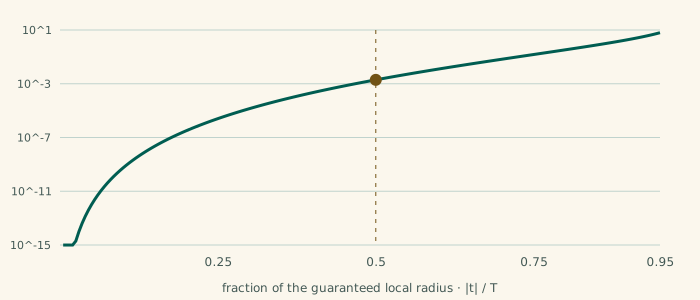
At a fixed nonzero time fraction, a higher degree makes this upper bound smaller. Near the edge of the guaranteed interval, the bound grows.
bN is the position bound divided by δ.
η = |t| / T < 1 · N is the truncation degree.
Choose a guarantee
At η = 0.50, degree 13 is the least degree from 1 to 24 meeting this target. Bound / δ: 6.104e-5.
A sufficient bound under the paper’s assumptions; no measured accuracy or floating-point error guarantee. An unavailable target leaves the selected degree unchanged.
Inside / 0 ≤ η < 1
For example, η = 0.50 and N = 8 give bound / δ = 1/512. The chart lets you inspect other interior values.
At the edge / η = 1
The denominator vanishes. No finite value is assigned here. This does not imply that the physical motion collides or that every series diverges there.
Bound / δ = ηN+1 / [2(1 − η)], where η = |t|/T < 1 and δ is the initial minimum separation divided by 16. Vertical values below 10⁻¹⁵ are clipped on the plot; the readout retains them.
This bound excludes floating-point roundoff. It is not a measured error or a collision time.
| Time fraction η | Position bound / δ |
|---|---|
| 0.25 | 2.543e-06 |
| 0.50 | 1.953e-03 |
| 0.75 | 1.502e-01 |
| 0.95 | 6.302e+00 |
In gratitude
To the observers who kept records, the mathematicians who found patterns, the teachers who made difficult ideas approachable, and the builders who gave others new ways to see.
This work stands within that human history. Some contributors are celebrated; many are unnamed. Their care made these questions ours to inherit. We offer this study with respect for what came before, and excitement for what people may discover next.
An original dedication for this project—not a quotation from a historical source.
A few landmarks in a much wider history
The Principia joins laws of motion and universal gravitation into a mathematical account of celestial motion.
Euler’s published straight-line study is a landmark in the search for special three-body configurations.
Equilateral configurations offer another remarkable family, including unequal masses.
Qualitative dynamics brings new ways to understand complexity beyond a single explicit formula.
Convergent-series work expands what an exact representation can mean. The original article carries a 1912 printing notice; the publisher catalogues it as 1913.
Better explanations, careful computation, independent review, and new questions carry the work forward.
Selected landmarks, not a complete history or claim of priority. See the reading notes. The classical families belong to the history of mathematics; this project contributes its documented exploration and reference resources.
Read the research
Explicit classical circular and nonradial parabolic families, radial collapse and expansion with collision excluded, the fixed-planar-shape boundary, linear instability of the circular symmetric Euler family, and an infinite local series with a convergence radius and truncation bound.
Download the manuscript · Markdown ↓Three original responses under a shared prompt and profile, followed by an unblinded synthesis. A reported intake deviation is retained. The study supports inspection of these outputs, not a model ranking.
The full local record preserves those responses and review history.
No general finite closed form, independent mathematical certification, protected examination, numerical trajectory study, or measured learning or deployment benefit is established.
Each special family has its own time domain; radial collision is excluded. The general series is local and infinite. A display check is distinct from a mathematical examination.
A post-study paper follows the spacecraft hypothesis through its equations, finite results and tether-research precedents. Known coupling is supported; a novel mechanism and mission utility remain unestablished.
Read the spacecraft theory paper →Website edition 029 is a visual companion to manuscript v0.7 and its equation supplements 018–019, with a separate propulsion working paper 028. The included Markdown edition carries its scientific main text, declarations, and reading notes, with internal file links and local operational records removed from the deployable files. The full research record retains the original model responses, configurations, and review history. This page explains the results; the manuscript provides their assumptions and limitations.
Excitement for what comes next
The next step can be modest and meaningful: help someone catch a wrong calculation, understand a difficult distinction, or follow an idea all the way back to its evidence.
Compare an independent implementation with exact reference cases, including examples designed to expose misleading agreement.
Pair motion with equations, words, and inspectable states. Then ask whether people learn something they can use elsewhere.
Credit inherited knowledge, preserve uncertainty, and give future contributors a clear place to begin.
These are directions for future evaluation. Their educational, accessibility, efficiency, and societal effects have not been measured.
The reading room / trace & acknowledgment
The Lucas Museum of Narrative Art, founded by George Lucas and Mellody Hobson, is the user’s stated inspiration. Its campus account credits Ma Yansong/MAD and Mia Lehrer/Studio-MLA. Its art and artists page keeps the works and their makers visible. We transfer that care into original mathematical narration and diagrams; no affiliation is implied.
Torralba, Isola and Freeman’s Foundations of Computer Vision: Single View Metrology and Stereo Cues. Web rendering context: W3C CSS Transforms Level 2. Motion control: W3C animation-from-interactions guidance.
Closer to the work. This edition reads selected passages in four primary texts, building on the fifteen contextual records traced in edition 012. Euler remains catalogue-only. A source supports the claim beside it; it does not independently certify our derivations. Read the primary-text ledger and precise access limits. Earlier contextual trace.
The companion art. A shared shape and Looking again are original AI-generated interpretations produced with image_gen under Ergentics art direction in 2026. They are not authenticated likenesses or historical paintings. The mathematical diagrams are separate, modern reference figures. Read the art notes and save the originals.
Ergentics, LLC directs this project. Codex supplied mathematical exposition, coding, editorial and image-generation assistance. Classical mathematical contributions retain their historical attribution; the librarians, transcribers and careful readers who make them available are part of this story.